Tutorial 4
Activity: Inference from Causal Explanations
Type Causation and Token Causation
Counterfactuals
Token Causation Revisited
Causal Selection
- Abnormal inflation
- Normal inflation
Activity: Blicket experiment with explanations!
In this activity you will pretend to be experimenters and participants, looking to see how well people generalize causal relationships from experiments and explanations.
Procedure
Experimenter:
Grab several (6-10) objects and place them in a bag. Select 2-3 objects to be blickets.
Two conditions:
| Known rule | Known blickets |
|---|---|
| You tell the participant what the rule for the blicket detector is | You tell the participant which objects are blickets |
Keep in mind that if your detector requires 2 or 3 blickets then you should have at least that many blickets in your three objects (to be nice). Then, you must pick a blicket machine:
- Disjunctive (any blicket will make the machine go off)
- Conjunctive (requires two blickets for the machine to go off)
- Anything more complex
- exactly 1 or 2 blickets
- Blicket and a non Blicket (mean one)
- etc.
When your participant places 2-3 onjects on the blicket machine you must tell them:
- If the machine turns on
- Why the machine turned on
- Point to any of the objects on the machine
Participant
Your job as is to determine what objects are blickets or what makes the detector go off (depending on condition).
You have 3 experiments you can conduct selecting any set of the objects and place them on the machine. The experimenter will tell you if the detector turns on.
I recommend you write down your results.
Type and Token Causes
Type causation
Type causation refers to the variables in a causal model:
$ A \rightarrow C \leftarrow B$
The type causation relations are:
- $A$ causes $C$
- when $A>18$: (meets condition)
- $B$ causes $C$
- when $B=True$: (happens)
Token events
Each causal variable is presumed to have a domain of posible values:
- $A \in \mathbb{Z}$ (Integers)
- $B \in \{True,False\}$
- $C \in \{True,False\}$
Token events represent the values that the causal variables can take on:
- $A=20$
- $B=True$
- $C=True$
Token causation
Other names for this phenomenon are:
- Actual Causation
- Token Caustion
- Singular Causation
Given the type level causal relations do we know when token events actually cause other events?
- Did ($A=20$) cause ($C=True$)?
- Did ($B=True$) cause ($C=True$)?
Counterfactuals
Counterfactuals presuppose there having been a token event---something has to actually happen.
Counterfactuals state judgments about what would have happened counter to the (f)actual world.
|Event | Counterfactual
--- | ---
|Bill threw a ball at the vase and shattered it upon impact. | If Billy had not thrown the ball at the vase it would not have shattered.
- What are the type level causes of this scenario?
- What are the token events this scenario?
Lewis (1973) provides a semantics for counterfactuals.
Given {$A=a$ , $B=b$}
If $A$ had not ($A=a$), then $B$ would not have ($B=b$).
This is true only if in all the closest worlds to the actual world in which $A$ takes on values ($A\neq a$), $B$ takes on values ($B\neq b$).
Token Causation Revisited
So if the vase is shattered, what is the token/actual cause of it shattering?
Popular theory: Counterfactual Dependence
Billy throwing the vase is a token cause because if Billy had not thrown the ball, the vase would not have shattered. Thus, the vase shattering counterfactually depends on Billy throwing the ball.
What about the following cases:
- If the vase had been covered by a plastic case, the vase would not have shattered.
- Presupposition: The vase was not covered by a plastic case.
- If Suzy had stopped Billy from throwing the ball, the vase would not have shattered.
- Presupposition: Suzy did not stop Billy from throwing the ball.
All of these satisfy the counterfactual dependence condition...
Which one is the token/actual cause?
Causal Selection
Alice and Bob are playing a special game of basketball. In this game they are on a team and they need to score a basket to win.
In one case 1. both of them needs to score to win, in the other 2. only one of them need to score a basket to win.
$ A \rightarrow W \leftarrow B$
- $W := A=1 \land B=1$
- $W := A=1 \lor B=1$
Suppose we know Alice is a spectacular basketball shooter, and Bob is new and not quite good at scoring baskets.
One way to represent this probabilistically is to say: $P(A=1) > P(B=1)$
Suppose we are in a situation where both Alice and Bob scored a basket, and they won the game!
Who is the cause of the team winning?


Theories of Causal Selection
These are theories that aim to find the token causes and their rspective effect size.
Related idea is causal blame (Zultan et al, 2012) and responsibility (Lagnado et al, 2013).
Necesity and Sufficiency (Icard et al., 2017)
How necessary is the event to cause the outcome?
- Maximum score if necessary in all conditions
- Somewhat necessary if necessary under different conditions
How sufficient is the event to cause the outcome?
- Maximum score if sufficient alone
- Somewhat sufficient if sufficient under different conditions
How these different conditions are defined is what gives variability and explanatory power to this theory.
Counterfactual Effect Size (Quillien & Lucas, 2023)
Considers which variable has the strongest effect size across counterfactual worlds.
Like Lewis, this considers the most normal and closest worlds to the actual world.
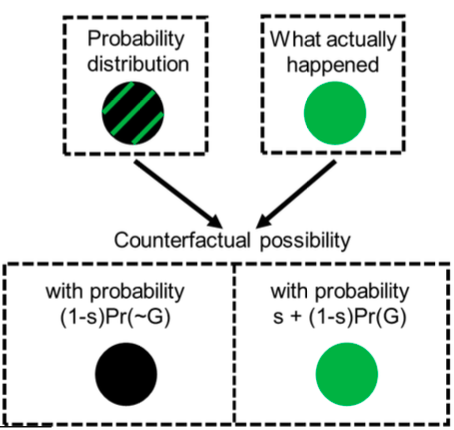
Then in each world it counts wether changing the cause would have an effect on the outcome.
$ \kappa_{C \rightarrow E} = \frac{1}{n} \frac{\sigma_C}{\sigma_E} \sum_i (\frac{\Delta E}{ \Delta C} )_i $